
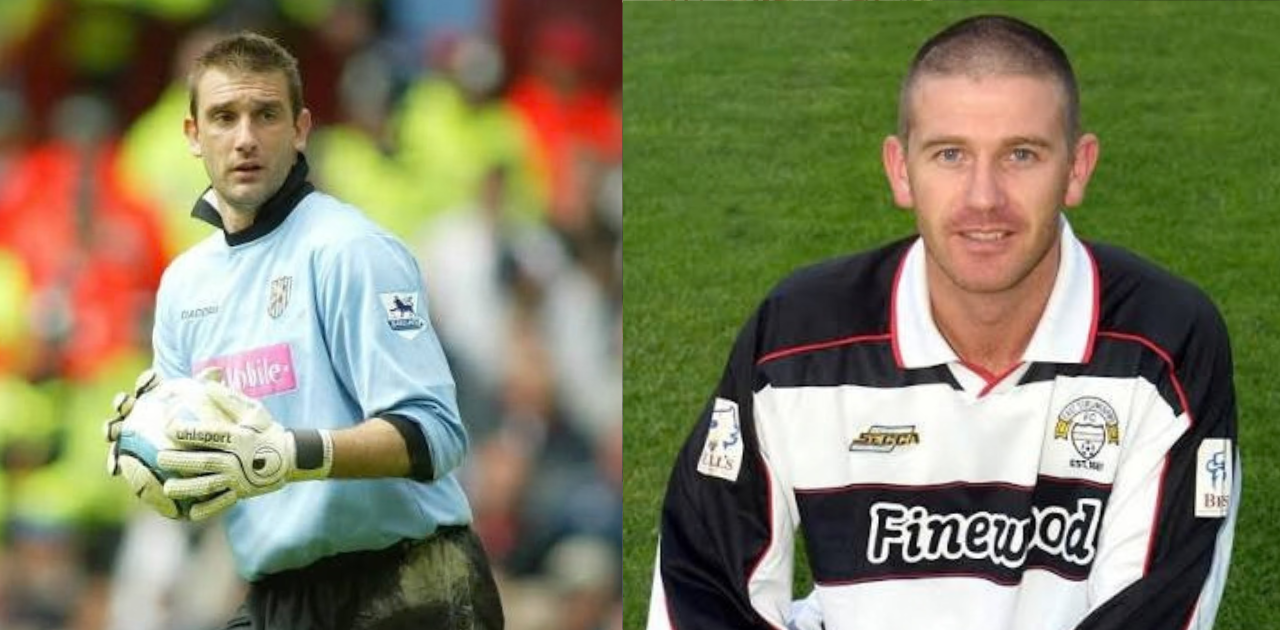

Russell Hoult is a former English professional goalkeeper whose career stretched across more than two decades and included important spells with Leicester City, Derby County, Portsmouth, West Bromwich Albion, Stoke City, Notts County, Darlington, and Hereford United. Born on November 22, 1972, in Ashby-de-la-Zouch, he developed from a young goalkeeper in Leicester City’s system into an experienced professional who accumulated hundreds of senior appearances.
For many supporters, the name Russell Hoult is most strongly associated with West Bromwich Albion. His time at The Hawthorns was the defining period of his career, particularly the 2001–02 campaign when West Brom won promotion to the Premier League and Hoult was selected in the PFA First Division Team of the Year. His performances established him as one of the standout goalkeepers in the division.
His story, however, extends beyond statistics and promotion campaigns. It includes years of loan moves, the challenge of competing for a starting position, Premier League football, coaching, management, and a difficult later chapter involving serious illness. The following profile brings those elements together while distinguishing documented facts from claims that are less firmly established.

Russell Hoult’s Early Life and Football Beginnings
Russell Hoult was born in Ashby-de-la-Zouch, England, and entered Leicester City’s youth system before beginning his senior career. His development was typical of a young goalkeeper trying to establish himself in professional football: opportunities were limited at first, and loan spells became an important part of his education.
During his Leicester years, he spent time on loan with Lincoln City, Blackpool, Cheltenham Town, Kettering Town, Bolton Wanderers, and later Lincoln City again. These moves gave him something that reserve football could not always provide: regular exposure to senior matches, physical pressure, unfamiliar teammates, and the responsibility that comes with being the last line of defence. His career record shows how frequently he moved during those formative years.
For a goalkeeper, this kind of experience can be particularly valuable. Outfield players can sometimes influence a match through frequent touches, but a goalkeeper may spend long periods observing before being required to make one decisive intervention. Loan football teaches concentration, communication, positioning, and resilience. Hoult’s early career was therefore less about immediate stardom and more about gradually building the experience necessary to become a dependable first-choice goalkeeper.

The Derby County Years and Premier League Breakthrough
A major turning point came when Hoult moved to Derby County. His initial move was made permanent in 1995, and he became an important member of the club’s squad during a period that included promotion to the Premier League. Derby’s return to the top flight provided Hoult with the opportunity to test himself against some of England’s best attacking players.
His Premier League statistics demonstrate that he was not merely a squad goalkeeper. During the 1996–97 season, he made 31 starts for Derby in league competition according to FBref, playing more than 2,800 minutes. He also recorded a 72.9 percent save rate in the available data. He remained involved during subsequent Premier League seasons, including 1998–99 and 1999–2000.
This period was significant because Premier League goalkeeping demands a combination of technical ability and mental strength. Strikers attack space quickly, crosses arrive with greater pace, and mistakes can immediately change the outcome of a match. Hoult’s time at Derby gave him valuable top-flight experience before another career transition took him to Portsmouth and eventually West Bromwich Albion.

Portsmouth and the Move to West Bromwich Albion
Hoult joined Portsmouth in 2000, initially on loan before the move became permanent. He made 40 league appearances for Portsmouth across the loan and permanent portions of his spell, according to historical statistical records. His time at Fratton Park was relatively short, but it positioned him for one of the most important moves of his career.
In January 2001, West Bromwich Albion signed Hoult. Sky Sports lists the transfer from Portsmouth to West Brom at £500,000, while other historical accounts give slightly different figures, illustrating why transfer-fee claims should be treated carefully when sources disagree.
The move proved highly consequential. West Brom needed a goalkeeper capable of providing stability during a promotion push, and Hoult quickly became a central part of the team. His performances during the following season would become the strongest statistical and competitive evidence of his quality.
Russell Hoult and West Bromwich Albion’s Promotion Push
The 2001–02 season was arguably the peak of Russell Hoult’s career. West Bromwich Albion were competing in the First Division, the second tier of English football at the time, with Premier League promotion as the objective. Hoult became a key defensive figure and played 45 league matches, according to historical records.
His contribution was not simply about making spectacular saves. Goalkeeping at promotion-chasing clubs is often about consistency. A goalkeeper must deal with crosses, organize defenders, make routine saves reliably, and produce decisive interventions when the team is under pressure. Hoult’s performances helped West Brom build one of the strongest defensive records in the division.
One particularly memorable moment came against Watford on September 15, 2001. With West Brom leading 2–1, Hoult saved a late Marcus Gayle penalty to preserve the victory. That type of intervention captures the value of a goalkeeper in a single moment: one save can protect an entire team’s work across ninety minutes.
PFA Recognition and the 2001–02 Season
The quality of Hoult’s campaign was formally recognized when he was selected in the PFA First Division Team of the Year for 2001–02. The team included prominent players such as Graham Alexander, Darren Moore, Joleon Lescott, Eyal Berkovic, and Robert Prosinečki, making Hoult’s inclusion an important individual distinction.
That recognition is especially useful when assessing his career because it provides independent context beyond club statistics. Being selected by fellow professionals indicated that his performances were respected within the football community. West Brom’s successful promotion campaign and Hoult’s individual recognition therefore reinforced each other.
| Career category | Documented detail |
|---|---|
| Full name | Russell Hoult |
| Date of birth | November 22, 1972 |
| Birthplace | Ashby-de-la-Zouch, England |
| Position | Goalkeeper |
| Height | Around 1.93 m |
| Youth club | Leicester City |
| Major Premier League clubs | Derby County, West Bromwich Albion, Stoke City |
| Notable promotion | West Bromwich Albion, 2001–02 |
| Individual honour | PFA First Division Team of the Year, 2001–02 |
| West Brom league appearances | About 190 in club records |
| Later career | Coaching, management, and goalkeeping work |
Life in the Premier League With West Brom
Promotion gave Hoult another opportunity to establish himself in the Premier League. West Brom entered the top flight with a squad built around players who had earned promotion, and Hoult remained an important part of the side.
One of the more notable performances from his Premier League period came against Aston Villa in November 2002. West Brom earned a 0–0 draw after Hoult saved a Dion Dublin penalty. Penalty saves are often remembered because of their obvious drama, but their tactical importance is just as significant: they can turn a likely defeat into a valuable point.
Hoult was also monitored by England manager Sven-Göran Eriksson during this period, although he never earned a senior England cap. That detail provides useful perspective. Being considered at international level demonstrates that he was operating within a competitive group of Premier League goalkeepers, even though the final step into the England squad did not materialize.
West Bromwich Albion’s Relegation and Return
West Brom’s first Premier League stay ended with relegation, but the club bounced back quickly. Hoult remained part of the team during the following campaign and was involved as West Brom returned to the top flight at the first opportunity.
This part of his career demonstrates one of the less glamorous realities of professional football: players often experience promotion and relegation in rapid succession. A goalkeeper needs to adapt to different styles of play, different levels of pressure, and changing expectations. At a promoted club, the priority may be survival; in the Championship, the expectation can immediately shift toward winning the title or securing another promotion.
Hoult’s continued presence during these transitions helped make him one of West Brom’s established players of the period. His league record for the club is substantial, with historical sources recording around 190 league appearances between 2001 and 2007.
Injuries, Competition, and the Later West Brom Years
Professional goalkeepers often enjoy long careers because the position relies heavily on anticipation and positioning rather than the constant running required of many outfield roles. Nevertheless, injuries can dramatically alter a goalkeeper’s standing because a replacement may take the opportunity and retain the position.
Hoult experienced this reality during his West Brom career. A groin injury affected his position at the beginning of the 2005–06 season, and he subsequently had a loan spell with Nottingham Forest. His West Brom league appearances dropped sharply during that season before he returned to the club.
This is an important part of his biography because it prevents the career from being reduced to a simple rise-and-fall narrative. Successful professional careers are rarely linear. Players can move from first choice to substitute, from Premier League starter to lower-division veteran, and from player to coach. Hoult’s later career followed exactly that kind of progression.
Stoke City, Notts County, Darlington, and Hereford
In January 2007, Hoult moved to Stoke City. His time there was comparatively brief, and he subsequently spent periods with Notts County. He later joined Darlington on loan and eventually moved to Hereford United. His career statistics show the pattern of an experienced goalkeeper continuing to find opportunities after his most prominent Premier League years.
These later clubs were important for another reason: they demonstrated that Hoult’s value extended beyond his years at the highest level. Experienced goalkeepers can provide leadership even when they are no longer playing every week. They can help younger defenders understand positioning, organize set pieces, and cope with the psychological pressure of difficult matches.
At Hereford, Hoult’s role also began to move beyond playing. The club appointed him as a goalkeeping coach in 2010, and he later became assistant manager under Jamie Pitman. In February 2011, he registered as a player again to provide goalkeeping cover.
Russell Hoult’s Coaching and Management Career
The transition from playing to coaching is a natural but demanding step for professional footballers. Playing ability does not automatically translate into coaching skill. A coach must explain techniques, diagnose mistakes, manage personalities, and understand how individual development fits into a team’s wider tactical structure.
Hoult began taking on those responsibilities at Hereford United. His goalkeeping background made him a logical choice for specialist coaching, while his later role as assistant manager gave him exposure to broader aspects of football management. He subsequently became player-manager and club president of Thringstone Miners Welfare in 2012.
The Thringstone role represented another stage in his football education. Managing at a smaller club requires versatility because resources, staffing, and player availability are different from those found at Premier League clubs. A manager may need to think simultaneously about training, recruitment, match preparation, administration, and club development.
What Made Russell Hoult an Effective Goalkeeper?
A statistical profile provides one perspective, but goalkeeping is also a position where qualitative traits matter enormously. Historical scouting descriptions of Hoult emphasize his command of the penalty area and his ability to handle difficult crosses.
That style fits the needs of a traditional English goalkeeper of his era. At nearly 1.93 metres tall, Hoult possessed the physical profile to challenge for aerial balls, while his experience allowed him to judge when to come off his line and when to remain in position. A goalkeeper who controls crosses effectively can reduce the number of dangerous second balls that defenders have to deal with.
His penalty-saving record also contributed to his reputation. The late stop against Watford and the save from Dion Dublin against Aston Villa were particularly memorable examples. These moments show the value of composure: a penalty is a highly concentrated contest in which the goalkeeper has only a fraction of a second to react and choose a direction.
Russell Hoult’s Career Statistics in Context
Career statistics can sometimes create misleading impressions if they are read without context. Different databases count competitions and substitute appearances differently, while historical records can contain variations in totals. Some sources list 445 senior appearances across Hoult’s career, while the Premier League’s own player profile records 141 Premier League appearances.
The broader picture is clear even where individual databases differ. Hoult had a long professional career, played extensively in England’s top two divisions, appeared in the Premier League for Derby County and West Bromwich Albion, and accumulated substantial experience across several clubs.
| Club | Period | Career significance |
|---|---|---|
| Leicester City | 1991–1995 | Professional development and early senior experience |
| Derby County | 1995–2000 | Major breakthrough and Premier League football |
| Portsmouth | 2000–2001 | Regular first-team football before West Brom move |
| West Bromwich Albion | 2001–2007 | Defining spell and promotion success |
| Stoke City | 2007–2008 | Later Championship/Premier League experience |
| Notts County | 2008–2010 | Experienced goalkeeper role |
| Darlington | 2009 | Short loan spell |
| Hereford United | 2010–2012 | Playing and coaching transition |
| Thringstone Miners Welfare | 2012–2013 | Player-manager and club leadership |
Russell Hoult’s Health Battle and Later Life
A major later chapter in Hoult’s life became public through his family in 2025. His daughter Kayleigh established a fundraising campaign stating that he had been diagnosed with primary sclerosing cholangitis in September 2023 and stage-four bile duct cancer, or cholangiocarcinoma, in August 2024. The family said both conditions had subsequently been described as terminal and that he was receiving palliative care.
This is an area where precision matters. Medical information is deeply personal, and public reporting should rely on statements from the individual or family rather than speculation. The family’s fundraising page provides the clearest primary-source account of the diagnosis and its seriousness. A 2025 report also described his children taking part in a Leicester running event to raise money for the AMMF, a charity focused on cholangiocarcinoma.
His daughter described him as “a character” who remained positive through difficult circumstances, according to the family’s fundraising account. That description adds a human dimension to a career that is otherwise easy to reduce to match appearances, promotions, and clean sheets.
As of the latest publicly documented reports located for this article, the family’s 2025 account remains the clearest source on his health situation. It would be inappropriate to infer a later medical outcome without reliable reporting confirming it.
The Importance of Russell Hoult to West Bromwich Albion
For West Brom supporters, Hoult’s importance is closely linked to the club’s early-2000s transformation. He was the goalkeeper during a period when Albion moved between the Championship and Premier League and established themselves as a serious promotion contender.
His 2001–02 season stands out because it combined team success with individual recognition. West Brom achieved promotion, while Hoult was named in the PFA First Division Team of the Year. He also produced decisive penalty saves that directly influenced important results.
In 2004, he was reportedly included among 16 players selected in a West Bromwich Albion poll connected with the club’s 125th anniversary celebrations. That provides another indication of how highly his contribution was regarded by supporters and the club’s historical community.
Common Misconceptions About Russell Hoult
One misconception is that Hoult was primarily a Premier League goalkeeper. While the Premier League was an important part of his career, a large portion of his most productive football came in the second tier. His First Division campaign with West Brom was arguably more significant to his legacy than any single Premier League season.
Another misconception is that a goalkeeper’s value can be judged entirely by clean sheets or save percentages. Modern analysis recognizes that goalkeeping involves positioning, cross management, communication, decision-making, distribution, and defensive organization. Historical data can tell us what happened, but it does not always explain why it happened.
There is also a tendency in online biographies to present every career total as definitive. In reality, historical football databases can differ. For that reason, the most reliable approach is to use authoritative competition records where available and clearly identify broader career totals as database-derived figures.
Why Russell Hoult’s Career Still Matters
The enduring interest in Russell Hoult comes from the shape of his career. He was not a one-season sensation who disappeared after reaching the Premier League. Instead, he experienced nearly every stage of English professional football: youth development, loan football, promotion, Premier League competition, relegation, recovery, injury, club changes, coaching, and management.
That makes his career particularly useful for understanding the realities of professional football. Success is often cumulative. A young goalkeeper may spend years on loan before becoming a regular, and a player who reaches the Premier League may later return to the lower divisions and continue contributing through experience.
His later move into coaching also shows that football careers do not end when playing careers finish. Knowledge accumulated over hundreds of matches can become valuable in training younger goalkeepers and supporting teams from the technical area.
Frequently Asked Questions About Russell Hoult
Who is Russell Hoult?
Russell Hoult is a former English professional goalkeeper who played for clubs including Leicester City, Derby County, Portsmouth, West Bromwich Albion, Stoke City, Notts County, Darlington, and Hereford United. He also moved into coaching and management after his playing career.
When was Russell Hoult born?
Russell Hoult was born on November 22, 1972, in Ashby-de-la-Zouch, England. Major football databases including the Premier League and FBref list the same birth date and birthplace.
What position did Russell Hoult play?
Russell Hoult played as a goalkeeper. He was around 1.93 metres tall and became particularly associated with his ability to command the penalty area and deal with crosses.
Did Russell Hoult play in the Premier League?
Yes. played Premhttps://celebrityfocus.co.uk /ier League football with Derby County and West Bromwich Albion. The Premier League’s official profile records 141 appearances in the competition, although its historical data notes that some earlier career information is incomplete.
Did Russell Hoult ever play for England?
Russell Hoult did not win a senior England cap. He was, however, monitored by then-England manager Sven-Göran Eriksson during his Premier League career, demonstrating that he was considered among the notable goalkeepers of his era.
What was Russell Hoult’s biggest achievement?
One of the strongest achievements of Russell Hoult’s career was helping West Bromwich Albion win promotion to the Premier League in 2001–02. He was also selected for the PFA First Division Team of the Year that season, making the campaign a particularly important individual and team success.
What happened to Russell Hoult after football?
After his playing career, Russell Hoult worked in coaching, including as a goalkeeping coach at Hereford United. He later became assistant manager there and subsequently served as player-manager and club president of Thringstone Miners Welfare.
What is known about Russell Hoult’s health?
According to a fundraising page created by his daughter in 2025, he was diagnosed with primary sclerosing cholangitis in 2023 and stage-four bile duct cancer in 2024. The family said both conditions had become terminal and that he was receiving palliative care. Because this is sensitive medical information, the family’s own published account is the appropriate basis for these details.
Conclusion: The Lasting Legacy of Russell Hoult
Russell Hoult’s career is best understood as the story of a determined professional goalkeeper who built his reputation through experience rather than overnight fame. From Leicester City’s youth system and a series of early loan spells to Premier League football with Derby County and West Bromwich Albion, his journey reflects the persistence required to establish a long career in English football.
His West Brom years remain the centerpiece. Promotion in 2001–02, selection in the PFA First Division Team of the Year, memorable penalty saves, and years of service made him an important figure in one of the club’s most significant periods. His later work in coaching and management extended that football journey beyond the playing field.
The most recent public chapter has been far more difficult. His family’s 2025 fundraising campaign brought attention to serious illness while also highlighting his character and the support of his children.
Ultimately, Russell Hoult’s story goes beyond the conventional statistics of a former Premier League goalkeeper. It is a story of development, resilience, professional longevity, adaptation, and the human reality behind a football career. His legacy is not simply the number of matches he played, but the many different roles he fulfilled across English football and the lasting memories created during his years between the posts.