
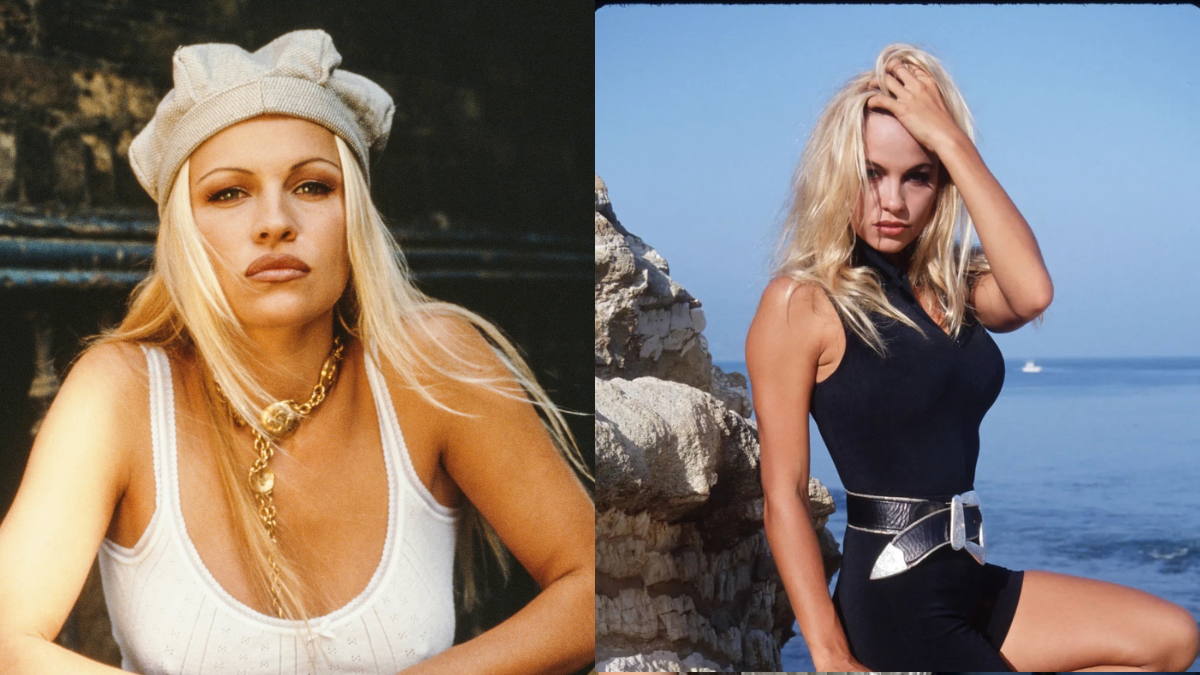

When people search for pamela anderson young, they are often looking for more than old photographs. They want to understand what Pamela Anderson was like before Baywatch transformed her into an international celebrity, how she entered modeling, where her famous image came from, and how her early experiences shaped the woman she eventually became.
Pamela Denise Anderson was born on July 1, 1967, in Ladysmith, British Columbia, Canada. She grew up in a working-class family, attended Highland Secondary School, and graduated in 1985. Before Hollywood, magazine covers, television fame, and global celebrity, Anderson was a Canadian teenager whose path into entertainment was almost accidental.
The story of pamela anderson young is especially interesting because her early career developed through a series of unexpected opportunities. A chance appearance on a stadium screen during a Canadian football game helped connect her with Labatt beer advertising, which eventually led to Playboy and then television. Her rise was not simply the result of a carefully planned Hollywood career; it developed through a chain of events that gradually moved her from British Columbia into the center of popular culture.

Pamela Anderson’s Childhood in British Columbia
The story of pamela anderson young begins in Ladysmith, a community on Vancouver Island in British Columbia. Anderson was raised by her parents, Barry Anderson, who worked as a repairman, and Carol Anderson, who worked as a waitress. She also had a younger brother, Gerry. Her childhood environment was considerably removed from the glamorous Los Angeles world she would later enter.
Anderson has described aspects of her childhood in her memoir Love, Pamela, published in 2023. Her recollections include difficult and traumatic experiences, including abuse and violence within her family environment. Those experiences are important to understanding her later reflections on identity, shame, resilience, and her relationship with her own body. They should not, however, be reduced to a sensational explanation for her later celebrity. Her childhood was one part of a much larger and more complicated personal history.
As a young person, Anderson was also interested in ordinary activities. Biography.com reports that she enjoyed spending time outdoors and regularly visited her local library for story time. She later attended Highland Secondary School, where she played volleyball, and graduated in 1985.
This contrast is central to understanding pamela anderson younhttps://www.google.com/search?sca_esv=080dae4805299e94&sxsrfg. The future international celebrity did not begin life surrounded by Hollywood connections. Her formative years were spent in a Canadian community, and the transition into entertainment happened only later.

Pamela Anderson as a Teenager
Teenage Pamela Anderson experienced a period of significant change. According to published biographical accounts, she left her parents’ home at 17 and moved into her own apartment. This was an important step toward independence and eventually helped set the stage for her move into a professional life away from her hometown.
During her adolescence, Anderson’s experiences also affected the way she viewed herself. In Love, Pamela, she revisited painful parts of her childhood and adolescence, including sexual abuse. Discussing these experiences as an adult allowed her to frame her earlier years in her own words rather than allowing the public image created by magazines and television to become the entire story.
For anyone researching pamela anderson young, this distinction matters. Photographs from her modeling years often dominate online searches, but photographs cannot explain the person behind them. Anderson’s later memoir provides additional context about the emotional and personal experiences that existed before her public career became enormous.
Her early life also illustrates why celebrity biographies benefit from chronology. Anderson was not born into the identity of a Hollywood sex symbol. That image developed gradually through modeling, publicity, television, and the entertainment industry’s response to her appearance.
The Move to Vancouver and a New Direction

In 1988, Anderson relocated to Vancouver, British Columbia. She began working at a tanning salon located in a fitness center and took aerobics classes. At this point, there was little reason to assume that she would become one of the most recognizable television personalities of the 1990s.
The turning point came in 1989 during a Canadian football game. Anderson appeared on the stadium’s large screen wearing a T-shirt featuring the Labatt beer logo. The company noticed her, and she was subsequently hired for advertising and promotional work. That seemingly ordinary moment became the beginning of a professional modeling trajectory.
This is one of the most memorable parts of the pamela anderson young story because it demonstrates how unpredictable entertainment careers can be. Instead of beginning with a conventional audition for a major film or television role, Anderson’s first major break came from being noticed by a brand during a sporting event.
Her transition from Vancouver fitness enthusiast to commercial model happened quickly. Once she had promotional work and public visibility, opportunities that would previously have been inaccessible began to appear.
How Labatt Beer Changed Pamela Anderson’s Career
The Labatt connection was important because it gave Anderson professional exposure. She was no longer simply a young woman who happened to attract attention; she had become a recognizable advertising model.
The commercial work also attracted attention from people in the entertainment industry. According to Biography.com, Hugh Hefner noticed Anderson’s whttps://celebrityfocus.co.uk/ork for Labatt and she was invited to pose for Playboy.
For , this moment represents the transition between local recognition and international visibility. Advertising gave her an initial platform, while Playboy provided a much larger one.
Her first Playboy cover appeared in October 1989, when she was 22. She later became Playmate of the Month in February 1990. Over the following years, she became one of the magazine’s most recognizable models and eventually appeared on its cover 14 times, according to Biography.com.
Anderson later described her first Playboy experience in unusually personal terms. Reflecting on the shoot, she said it was “my first feeling of freedom.”
That quote provides an important counterpoint to the simplified narrative often attached to her early career. Her modeling career was not experienced by her only as a commercial opportunity; she has also described it as part of a changing relationship with her body and personal identity.
Pamela Anderson Young and the Playboy Era
The phrase pamela anderson young is closely associated with her Playboy period because those photographs helped establish the visual identity that followed her throughout the 1990s.
Anderson moved to California later in 1989 to continue pursuing modeling. Her visibility increased rapidly, and her blonde hair, distinctive appearance, and glamorous image became central elements of her public persona.
But the Playboy era was only one part of her career. Anderson was already beginning to move toward television, and her modeling popularity helped create opportunities in acting. This transition is important because it shows that her success was not permanently confined to print media.
Her relationship with Playboy also changed over time. She remained connected to the publication for decades and eventually appeared on the January/February 2016 issue, which Biography.com describes as the magazine’s final nude issue.
In other words, the young model seen in late-1980s magazine photographs eventually became a veteran entertainment figure capable of revisiting and reframing the image that had originally made her famous.
Her First Television Break on Home Improvement
Anderson’s acting career gained an important early boost in 1991 when she became the “Tool Time Girl” on Home Improvement. The sitcom was already a successful television property, and her appearances introduced her to a much broader mainstream audience.
The move from modeling into television was strategically important, even if it was not initially the defining role of her career. Television allowed Anderson to demonstrate that she could function as an on-screen personality rather than simply as a photographic model.
For pamela anderson young, the Home Improvement period represents an important transitional stage. She was still closely associated with modeling, but entertainment producers were beginning to see her as a television performer.
That distinction would become crucial when she joined Baywatch.
Pamela Anderson and the Baywatch Breakthrough
The defining moment in the story of pamela anderson young came when Anderson joined Baywatch as C.J. Parker.
Anderson appeared on the series from 1992 through 1997, becoming one of its most recognizable stars. Baywatch, which had originally debuted in 1989, became a major international television phenomenon through syndication.
The series transformed Anderson’s public profile. Her red lifeguard swimsuit became one of the most recognizable costumes in television history, while her slow-motion beach appearances became closely associated with the show’s visual identity.
The impact of Baywatch went far beyond the United States. The series developed a huge international audience, and Anderson became recognizable in markets far removed from Canada and Hollywood.
| Career Stage | Approximate Period | Major Development |
|---|---|---|
| Childhood in British Columbia | 1967–1985 | Grew up in Ladysmith and attended school locally |
| Independent young adult | 1985–1988 | Left home and developed greater independence |
| Vancouver period | 1988–1989 | Worked at a tanning salon and became involved in fitness |
| Labatt breakthrough | 1989 | Gained attention after appearing on a stadium screen |
| Playboy era begins | 1989–1990 | Appeared on the cover and became Playmate of the Month |
| Early television | 1991 | Appeared on Home Improvement |
| Baywatch | 1992–1997 | Became an international television star |
| Later television and film | 1998 onward | Starred in V.I.P. and expanded into film and reality television |
The table illustrates why pamela anderson young searches should not focus exclusively on photographs. Her early years were a progression from ordinary Canadian life to advertising, modeling, television, and international fame.
Why Baywatch Became Such a Defining Moment
Baywatch was initially canceled after its first season but later returned in syndicated form and became a worldwide success. The program’s appeal was strongly connected to its beach setting, action-oriented lifeguard stories, large ensemble cast, and highly visual presentation.
Anderson’s role as C.J. Parker became central to her public identity. She was no longer primarily known as a magazine model; she was now a television character recognized by audiences around the world.
The show’s success also demonstrates how television can transform celebrity identity. Before Baywatch, Anderson had visibility in advertising and print. After Baywatch, she became a global entertainment personality whose appearance was immediately recognizable.
This period remains one of the main reasons people search for pamela anderson young photographs today. Fans often associate her early-1990s appearance with the cultural image of the era, particularly the fashion, hair, makeup, and beachwear associated with Baywatch.
Pamela Anderson’s Appearance and the Beauty Standards of the 1990s
The image of pamela anderson young is also connected to changing beauty standards in popular culture.
During the 1990s, celebrity magazines, television, advertising, and music videos heavily emphasized particular physical aesthetics. Anderson became one of the most visible representatives of that culture, but her image also illustrates how entertainment industries can amplify particular beauty ideals.
It is important to distinguish between Anderson’s appearance and the cultural expectations surrounding it. Her celebrity was shaped not only by her physical appearance but also by photography, styling, television production, publicity, costume design, and the marketing systems surrounding entertainment.
This broader context helps explain why her image became so enduring. She was not simply photographed; she became part of a recognizable visual language associated with 1990s celebrity culture.
The Difference Between Pamela Anderson’s Public Image and Her Private Identity
One of the most fascinating aspects of pamela anderson young is the gap between the image audiences saw and the person Anderson later described in her own writing.
Her public persona was heavily associated with glamour, sexuality, and Hollywood celebrity. Yet her memoir Love, Pamela offered a much more reflective account of childhood, relationships, motherhood, fame, and personal experiences.
That contrast became especially important with the 2023 Netflix documentary Pamela, a Love Story. The documentary presented Anderson’s story largely through her own perspective and addressed her rise to fame, personal relationships, and the notorious stolen intimate tape involving her and Tommy Lee.
This shift in perspective is significant. Instead of allowing the public to know her primarily through photographs and headlines, Anderson increasingly participated in telling her own story.
That process illustrates how celebrities can eventually reclaim or reinterpret images created during their younger years.
Pamela Anderson’s Early Relationships and Marriage to Tommy Lee
Anderson’s young-adult years also included a highly public relationship with Mötley Crüe drummer Tommy Lee. The pair married in 1995 after a remarkably brief courtship, and their relationship became one of the most heavily covered celebrity romances of the decade.
Their marriage produced two sons, Brandon Thomas and Dylan Jagger. It also became associated with serious controversy, including domestic violence and the theft and distribution of a private intimate recording. Lee was convicted of spousal abuse and served a jail sentence.
These events are sometimes presented in sensational terms, but the more important historical point is that Anderson’s early fame became inseparable from intense media attention. Her private life was repeatedly converted into public entertainment.
For readers exploring pamela anderson young, this period demonstrates how quickly celebrity culture can move beyond professional achievements and into personal relationships.
Pamela Anderson as a Young Mother
Anderson became a mother during one of the most visible periods of her career. She and Tommy Lee welcomed Brandon Thomas Lee in 1996 and Dylan Jagger Lee in 1997.
Balancing motherhood with the demands of television fame created another dimension to her public identity. Her life was no longer only about modeling, acting, and celebrity appearances. She was also raising children while working within a highly demanding entertainment industry.
This period is significant because it challenges the simplified image of pamela anderson young as only a model or television sex symbol. Her adult life involved professional responsibilities, family responsibilities, activism, writing, and increasingly complicated public scrutiny.
Over time, her sons also developed their own careers in entertainment and fashion, creating another generation of public interest in the Anderson family.
Pamela Anderson Beyond Baywatch
After leaving Baywatch, Anderson continued developing her television career. In 1998, she became the star and executive producer of V.I.P., a syndicated action-comedy series in which she played Vallery Irons. The show ran for four seasons through 2002.
She later appeared in projects including Stripperella, Stacked, Borat: Cultural Learnings of America for Make Benefit Glorious Nation of Kazakhstan, and reality television programs.
Her career demonstrates an important principle about celebrity longevity: an individual may become famous for one defining role but continue evolving through different formats.
The young Anderson associated with Baywatch eventually became a television producer, author, activist, documentary subject, cookbook author, and film performer.
That broader career makes the historical search for pamela anderson young more meaningful because it places her early image inside a much longer professional journey.
Her Activism and Changing Public Identity
Anderson has also been involved in animal rights and environmental causes. Biography.com notes her long association with PETA and other advocacy efforts, as well as public campaigning on issues including seal hunting in Canada.
Her activism complicated the stereotypical image that had dominated coverage of her during the 1990s. Rather than remaining solely a glamour celebrity, she developed a public identity that included political and humanitarian causes.
This evolution matters when discussing pamela anderson young because it shows how celebrity identities can change dramatically over time.
A photograph from the early 1990s captures a particular moment. It does not capture the entirety of the person’s beliefs, professional interests, or later development.
Pamela Anderson’s Memoir and Reclaiming Her Story
In 2023, Anderson published Love, Pamela, a memoir that revisited her childhood, career, relationships, and experiences with fame. She also read through old journals while working on the book, describing the process as a healing experience.
The memoir is particularly important for understanding pamela anderson young because it provides first-person context that photographs and old entertainment articles cannot supply.
A celebrity photograph shows how someone looked. A memoir can explain how that person remembers what was happening around the image.
This distinction is crucial when studying cultural figures. Public archives often preserve the image that sold magazines or attracted television audiences, while personal writing can reveal the emotional and social context behind those images.
Anderson’s memoir therefore adds another layer to the historical record of her early life.
Pamela Anderson’s 2023 Documentary
The Netflix documentary Pamela, a Love Story further expanded Anderson’s personal account. Released in 2023, it revisited her rise to fame and her experiences in relationships and the entertainment industry.
The documentary arrived at an interesting moment because it followed renewed public interest in Anderson’s story after the fictionalized Hulu series Pam & Tommy. Rather than focusing primarily on the perspective of outside observers, the documentary centered Anderson’s own account.
This made the contrast between pamela anderson young and Pamela Anderson later in life especially visible. The woman remembered through 1990s television was now speaking about that period from the perspective of someone who had lived through its consequences.
That change in perspective is one of the most important developments in understanding her legacy.
The Last Showgirl and a New Chapter
Anderson’s career experienced another significant phase with The Last Showgirl, a 2024 film directed by Gia Coppola. Anderson received a Golden Globe nomination for her performance, marking a notable moment in the later stage of her acting career.
The role was significant because it allowed audiences to reconsider Anderson primarily as an actor rather than only as the cultural icon created by Baywatch.
Her official website now highlights projects including The Last Showgirl, The Naked Gun, Love, Pamela, Pamela, A Love Story, and her cookbook I Love You.
That range of work demonstrates how far her career has moved beyond the young model who first appeared on a Canadian stadium screen.
Pamela Anderson’s Reinvention in Fashion and Beauty
Anderson’s later public appearances have also demonstrated a willingness to reconsider her signature beauty image. Her changing approach to makeup and fashion has attracted attention precisely because it contrasts with the heavily styled glamour associated with her younger years.
The significance is not simply cosmetic. It reflects a broader evolution in celebrity culture, where established stars increasingly control how they present themselves rather than maintaining the exact image that originally made them famous.
The visual difference between pamela anderson young and her later public appearances can therefore be understood as part of a larger personal and cultural transformation.
Instead of treating aging as a problem that must be hidden, Anderson has increasingly presented different versions of herself across different stages of life.
Why People Still Search for Pamela Anderson Young
The enduring interest in pamela anderson young comes partly from nostalgia. The 1990s remain an influential period in fashion, television, celebrity culture, and popular entertainment.
Anderson was one of the defining faces of that decade. Her Baywatch role, Playboy appearances, blonde hairstyle, red swimsuit, and Hollywood relationships all became part of the cultural memory of the era.
But nostalgia is not the only explanation.
People are also interested in the origin story. They want to know how a young woman from British Columbia became a globally recognized entertainer. That question turns a collection of old photographs into a much more interesting narrative about opportunity, media, beauty standards, television, and celebrity.
What Old Photographs Can and Cannot Tell Us
Photographs are useful historical evidence, but they have limits.
An old photograph can show clothing, hairstyle, makeup, physical appearance, location, and sometimes the context of a public event. It cannot automatically tell us what the person was thinking or experiencing emotionally.
That distinction is especially important with pamela anderson young searches because many online image galleries present photographs without meaningful context.
A responsible biography should therefore connect images to dates, professional milestones, and documented events.
The photograph becomes more useful when readers know whether it came from Anderson’s early modeling career, Baywatch, a public appearance, a film premiere, or another period.
Pamela Anderson’s Legacy as a Cultural Figure
Pamela Anderson’s cultural legacy cannot be reduced to one television role or one magazine.
She became a symbol of 1990s celebrity culture, but her career continued through television, film, activism, publishing, reality programming, documentary storytelling, and fashion.
The story of pamela anderson young is therefore best understood as the opening chapter of a much longer biography.
Her early image was created through a combination of personal appearance, media technology, entertainment marketing, television, photography, and audience fascination. Her later career demonstrates that a person can become famous for one image and still spend decades challenging, expanding, or redefining that image.
Frequently Asked Questions About Pamela Anderson Young
What was Pamela Anderson like when she was young?
Pamela Anderson grew up in Ladysmith, British Columbia, in a working-class Canadian family. She attended Highland Secondary School, played volleyball, and graduated in 1985. Her early life was far removed from the Hollywood celebrity culture that later surrounded her.
When did Pamela Anderson become famous?
Pamela Anderson’s first major public exposure came through Labatt advertising in Canada in 1989. She then became a Playboy cover model and gained mainstream television exposure on Home Improvement. Her international breakthrough came with Baywatch, where she played C.J. Parker from 1992 to 1997.
How old was Pamela Anderson when she first appeared in Playboy?
Pamela Anderson was 22 when she appeared on the cover of Playboy in October 1989. She subsequently became Playmate of the Month in February 1990 and went on to have a long association with the magazine.
How old was Pamela Anderson when she joined Baywatch?
Pamela Anderson was 24 when she began her Baywatch run in 1992. Her role as C.J. Parker became the performance most strongly associated with her rise to international fame during the 1990s.
Where did Pamela Anderson grow up?
Pamela Anderson grew up in Ladysmith, British Columbia, Canada. She later moved to Vancouver as a young adult before her modeling career developed and eventually took her to California.
What was Pamela Anderson’s first major modeling opportunity?
One of Pamela Anderson’s earliest major opportunities came after she was noticed at a Canadian football game while wearing a Labatt beer T-shirt. Labatt subsequently hired her for advertising, and her work attracted the attention that helped lead to her first Playboy appearance.
What did Pamela Anderson do before Baywatch?
Before Baywatch, Pamela Anderson worked in Vancouver, including at a tanning salon in a fitness center, and became involved in Labatt advertising after being noticed at a football game. She subsequently modeled for Playboy and appeared on Home Improvement before joining Baywatch.
Conclusion: Why Pamela Anderson’s Young Years Still Matter
The story of pamela anderson young is ultimately much richer than a collection of nostalgic photographs. Pamela Anderson began life in Ladysmith, British Columbia, moved toward independence as a teenager, relocated to Vancouver, and entered entertainment after an unexpected opportunity at a Canadian football game.
Her Labatt advertising work led to Playboy, Playboy opened the door to greater visibility, Home Improvement introduced her to television audiences, and Baywatch transformed her into an international star.
Yet the most interesting part of her biography is what happened after that initial fame. Anderson continued working in television and film, became an activist, published books, participated in documentary storytelling, and revisited her own history through Love, Pamela and Pamela, A Love Story. Her later career has demonstrated that the image of the young Baywatch star was only one chapter in a much larger life.
Understanding pamela anderson young therefore requires looking beyond appearance. The early photographs explain why audiences noticed her, but her biography explains how she became a cultural figure and how she later worked to tell her story on her own terms.
The lasting takeaway is that Pamela Anderson’s early image may have defined a particular era, but it does not define the whole person. Her journey from a small Canadian community to international celebrity, followed by decades of reinvention, makes her career a revealing case study in fame, media culture, personal identity, and the power of rewriting one’s own narrative.